We were around in 2008 when mantras like “housing prices will never go down” and “this time is different” were used to justify an expensive equity market. If we hadn’t had this experience, we might start to doubt our current beliefs about stock prices which are much less rosy than most pundits. Despite this recent history, the so called “experts” are once again quite confident in their prognostications. Their never cloudy crystal balls see nothing but sunshine and blue skies ahead.
Consider some recent statistics…
Long-only mutual funds just recorded $8.9 billion of inflows, the largest weekly increase since March 2000.
According to Bloomberg, hedge funds have taken their leverage up meaningfully to increase bullish wagers on stocks.
In December, the 20 most heavily shorted stocks in the S&P 500 returned 5.1% versus 0.7% for the rest of the index. That massive short covering is just another indication that many players have tilted strongly towards increasing equity exposure.
Finally, margin debt on the NYSE is at five-year highs.
The momentum is fierce. Most major stock indices are near multi-year highs. No one wants to get stampeded by the thundering herd. The bell hasn’t rung yet!
But wait a second!
Let’s not let emotion and rampant punditry get in the way of reality. We see a large number of major reasons stocks shouldn’t keep moving unabatedly higher. Let’s look at 10…
Wall Street just recently reduced GDP growth estimates for the 4th quarter to around 1% from roughly 2%. Just imagine what real GDP growth would be if the federal government wasn’t spending $100 billion more each month than it is taking in in tax revenues and if realistic inflation numbers were used as the adjustment factor.
Profits margins are about 30-40% above normal and will likely return to earth given obviously slow economic growth.
High frequency traders dominate market activity with their rapid-fire quotes and provide a false sense of security, driving complacency to historic highs. However, if real money investors ever decide to hit the sell button, those same traders will likely just unplug their computers, leaving bids hard to find.
Markets act as if Europe has been fixed, but the German economy contracted by 0.5% in the final months of 2012. France will likely need more budget cutting or tax increases as it just announced it will not hit its deficit targets….and these two nations are supposed to be the backbone of the continent!
Monetary policy remains unsustainable across the globe with dangerously bloated central bank balance sheets commonplace. Even the Fed, after the election of course, is suddenly wondering if maybe it may have to refrain from QE sooner rather than later.
Market darling Apple is about 30% off of its highs. We find it quite unusual to see this market leader pounded into submission without the indices reflecting any pain.
Germany is in the process of removing its gold from the custody of the Fed after decades of placing its trust in our central bank. Even the central bankers do not trust each other as much as the markets trust the central bankers.
The media’s cry that “China is the answer to all of our growth problems” has to be called into question when one looks at the facts. “Very shockingly, most of our bankers say less than 20% of their (China’s) lending goes to new loans,” says the Beige Book’s Leland Miller. “Most of it is going to debt rollovers or increases – they are not funding expansion. This calls into question just how sustainable this expansion is.”
The Russell 2000 sits near record levels, yet long-term unemployment in the U.S. sadly resides at levels not seen since WWII. Holy bubble, Batman! Massive fiscal and monetary stimuli are creating false hope.
The steel inventory-to-shipment ratio for December just hit levels last seen during the bust of 2008 according to BofA Merrill Lynch, adding to our conviction that 2013 is not coming out of the gate with a bang.
Call us stubborn, but we find it hard to reconcile these points with the fact that speculative positions in the historically volatile Russell 2000 small-cap index stand at extreme levels.
Maybe they do ring bells at tops, maybe not. But we do know that our primary job is to manage risk, and we see alot more than those who may simply be wearing earplugs.
Scott Brown
The views expressed on this blog are the opinions of the authors. This information is not intended as investment advice or to recommend the purchase or sale of securities. More information on Strategic Balance, LLC may be obtained by contacting investor relations.
Maybe They Do Ring Bells at the Top
We were around in 2008 when mantras like “housing prices will never go down” and “this time is different” were used to justify an expensive equity market. If we hadn’t had this experience, we might start to doubt our current beliefs about stock prices which are much less rosy than most pundits. Despite this recent history, the so called “experts” are once again quite confident in their prognostications. Their never cloudy crystal balls see nothing but sunshine and blue skies ahead.
Consider some recent statistics…
The momentum is fierce. Most major stock indices are near multi-year highs. No one wants to get stampeded by the thundering herd. The bell hasn’t rung yet!
But wait a second!
Let’s not let emotion and rampant punditry get in the way of reality. We see a large number of major reasons stocks shouldn’t keep moving unabatedly higher. Let’s look at 10…
Call us stubborn, but we find it hard to reconcile these points with the fact that speculative positions in the historically volatile Russell 2000 small-cap index stand at extreme levels.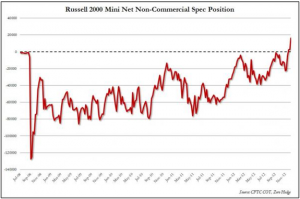
Maybe they do ring bells at tops, maybe not. But we do know that our primary job is to manage risk, and we see alot more than those who may simply be wearing earplugs.
Scott Brown
The views expressed on this blog are the opinions of the authors. This information is not intended as investment advice or to recommend the purchase or sale of securities. More information on Strategic Balance, LLC may be obtained by contacting investor relations.