Wall Street and the pundits are offering the hope that earnings will not respond to normal cyclical pressures because China’s growth has supposedly picked up and the U.S. has finally begun a sustainable recovery. New Japanese currency debasement talk has also captured the fancy of many in recent months. Never mind that markets are normalizing extremely high profit margins in the face of one of the most uncertain times in U.S. history. Those who spin the “this time is different” theme continue to drift further from reality.
And these are not the only head fakes. Given the rally in the Euro and higher risk bonds in Europe since the 2012 lows, the “consensus” seems to believe EU drama is over. But they are ignoring Italy’s political drama arising from the recent election (it looks like the populace there may not be too happy with what the “deciders” have decreed). Senior bank bond holders’ and depositors’ losses in Cyprus are another confidence shaker, but hardly enough to prevent the continued downward slide in volatility. Finally, with the “fiscal cliff” scare in the rearview mirror in the minds of some, downside risk in the U.S. has been almost eliminated according to the rose-colored glasses set. Besides the Fed “has our back!”
In our view, we are left with a less than inspiring global growth picture. Just take a look at comments from companies operating in the “real world”. Fedex just announced that it must reconfigure its Asian business because demand there is not what it expected. Caterpillar reported dismal demand for its heavy equipment. Steel demand remains at low levels according to numerous indstry participants. Oracle failed to meet market expectations in the software sector. Tiffany guided lower because sales remain punk. Yet stocks fail to reflect much, if any, bad news.
According to the Wall Street Journal, “Companies aren’t exactly confident about the economy. So far this quarter [referring to the first quarter], 101 companies in the S&P 500 have predicted weaker-than-expected earnings figures, compared to just 23 companies that have unveiled optimistic outlooks, according to figures compiled by Thomson Reuters. That’s the worst ratio since the third quarter of 2001. Not exactly a vote of confidence in the current economic conditions.” Bloomberg reported that, “Sales at casual-dining establishments fell 5.4 percent last month [February], after declining 0.6 percent in January and 1.6 percent in December, according to the Knapp-Track Index of monthly restaurant sales. This was the first three months of consecutive declines in almost three years, with consumers caught in a ‘very emotional moment,’ said Malcolm Knapp, a New York-based consultant who created the index and has monitored the industry since 1970.” We see strikingly little concern in the market for the equities of the affected companies; in fact, some sit at all-time highs.
We are well aware that the publicly traded homebuilders are seeing a big increase in demand and that car sales look good for now. Cheap money is helping fuel those sectors and that’s good to see in some sense, but we know that giving away money at Fed-created fantasy rates of interest cannot be healthy for long-term dynamics in those industries. In contrast, consumer sentiment as measured by the University of Michigan (see chart) paints a less than rosy picture.
As always, we like to look at the big picture to explain why many of us (call us stubborn) do not feel like the amazingly ebullient 70% bullish Market Vane for equities reading. It’s pretty simple…despite market euphoria, real income has been sadly stagnant for a number of years.
If job growth is as strong as some claim, why is the office building sector not reflecting it? Reuters just reported in a piece that, “The first-quarter [office] vacancy rate stood at 17 percent compared with 17.1 percent in the fourth quarter, according to preliminary figures from Reis. The vacancy rate was down a scant 0.30 percentage point from the prior first quarter. ‘It’s really in line with our expected trends, given that hiring hasn’t accelerated,’ said Victor Calanog, Reis’ vice president of research. ‘It’s so indicative of weak demand in the office sector that quarterly construction figures are at a historic low and yet vacancies are not really cratering.’” We found ourselves triple checking this story because it stunned even us. It points out quite clearly the sharp contrast between common perceptions and reality in the U.S.
Chairman Bernanke’s former right-hand man, Frederic Mishkin, just wrote a paper that calls into question the Fed’s ability to exit QE gracefully. According to a recent description of this piece in The Telegraph, “officials at the US Federal Reserve may be more worried than they have let on about the treacherous task of extricating America from quantitative easing. This is an unsettling twist, with global implications. A new paper for the US Monetary Policy Forum and published by the Fed warns that the institution’s capital base could be wiped out ‘several times’ once borrowing costs start to rise in earnest.”
Such an admission certainly does not diminish our concern that the current strategies of reckless deficit spending and money printing are unsustainable and de-stabilizing in the long run. It makes us wonder why in his public comments Chairman Bernanke cheers higher equity prices without mentioning the major risks building in the system because of his policies. QE has caused many to allocate significant sums to what we perceive to be a quite overvalued market in a speculative display of blind faith. We just don’t think it’s a wise investment strategy to bet that one can get out the door instantly when the Chairman utters the words that the Fed is going to remove liquidity or even do less quantitative easing. In fact, that’s no investment strategy at all, but it appears to be the operative rationale at the moment.
We end with a question: if the global landscape were as strong as many equity market participants claim, wouldn’t the Fed already be tightening?
The views expressed on this blog are the opinions of the authors. This information is not intended as investment advice or to recommend the purchase or sale of securities. More information on Strategic Balance, LLC may be obtained by contacting investor relations.
More Head Fakes
Wall Street and the pundits are offering the hope that earnings will not respond to normal cyclical pressures because China’s growth has supposedly picked up and the U.S. has finally begun a sustainable recovery. New Japanese currency debasement talk has also captured the fancy of many in recent months. Never mind that markets are normalizing extremely high profit margins in the face of one of the most uncertain times in U.S. history. Those who spin the “this time is different” theme continue to drift further from reality.
And these are not the only head fakes. Given the rally in the Euro and higher risk bonds in Europe since the 2012 lows, the “consensus” seems to believe EU drama is over. But they are ignoring Italy’s political drama arising from the recent election (it looks like the populace there may not be too happy with what the “deciders” have decreed). Senior bank bond holders’ and depositors’ losses in Cyprus are another confidence shaker, but hardly enough to prevent the continued downward slide in volatility. Finally, with the “fiscal cliff” scare in the rearview mirror in the minds of some, downside risk in the U.S. has been almost eliminated according to the rose-colored glasses set. Besides the Fed “has our back!”
In our view, we are left with a less than inspiring global growth picture. Just take a look at comments from companies operating in the “real world”. Fedex just announced that it must reconfigure its Asian business because demand there is not what it expected. Caterpillar reported dismal demand for its heavy equipment. Steel demand remains at low levels according to numerous indstry participants. Oracle failed to meet market expectations in the software sector. Tiffany guided lower because sales remain punk. Yet stocks fail to reflect much, if any, bad news.
According to the Wall Street Journal, “Companies aren’t exactly confident about the economy. So far this quarter [referring to the first quarter], 101 companies in the S&P 500 have predicted weaker-than-expected earnings figures, compared to just 23 companies that have unveiled optimistic outlooks, according to figures compiled by Thomson Reuters. That’s the worst ratio since the third quarter of 2001. Not exactly a vote of confidence in the current economic conditions.” Bloomberg reported that, “Sales at casual-dining establishments fell 5.4 percent last month [February], after declining 0.6 percent in January and 1.6 percent in December, according to the Knapp-Track Index of monthly restaurant sales. This was the first three months of consecutive declines in almost three years, with consumers caught in a ‘very emotional moment,’ said Malcolm Knapp, a New York-based consultant who created the index and has monitored the industry since 1970.” We see strikingly little concern in the market for the equities of the affected companies; in fact, some sit at all-time highs.
We are well aware that the publicly traded homebuilders are seeing a big increase in demand and that car sales look good for now. Cheap money is helping fuel those sectors and that’s good to see in some sense, but we know that giving away money at Fed-created fantasy rates of interest cannot be healthy for long-term dynamics in those industries. In contrast, consumer sentiment as measured by the University of Michigan (see chart) paints a less than rosy picture.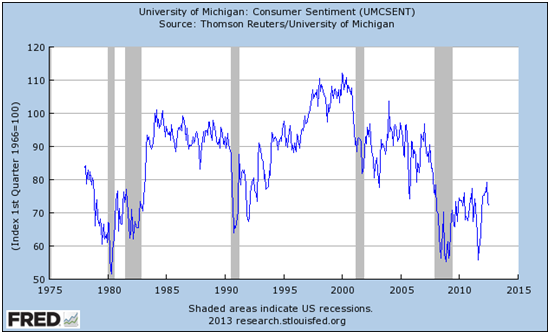
As always, we like to look at the big picture to explain why many of us (call us stubborn) do not feel like the amazingly ebullient 70% bullish Market Vane for equities reading. It’s pretty simple…despite market euphoria, real income has been sadly stagnant for a number of years.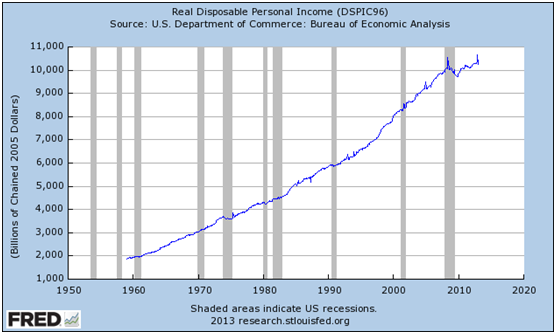
If job growth is as strong as some claim, why is the office building sector not reflecting it? Reuters just reported in a piece that, “The first-quarter [office] vacancy rate stood at 17 percent compared with 17.1 percent in the fourth quarter, according to preliminary figures from Reis. The vacancy rate was down a scant 0.30 percentage point from the prior first quarter. ‘It’s really in line with our expected trends, given that hiring hasn’t accelerated,’ said Victor Calanog, Reis’ vice president of research. ‘It’s so indicative of weak demand in the office sector that quarterly construction figures are at a historic low and yet vacancies are not really cratering.’” We found ourselves triple checking this story because it stunned even us. It points out quite clearly the sharp contrast between common perceptions and reality in the U.S.
Chairman Bernanke’s former right-hand man, Frederic Mishkin, just wrote a paper that calls into question the Fed’s ability to exit QE gracefully. According to a recent description of this piece in The Telegraph, “officials at the US Federal Reserve may be more worried than they have let on about the treacherous task of extricating America from quantitative easing. This is an unsettling twist, with global implications. A new paper for the US Monetary Policy Forum and published by the Fed warns that the institution’s capital base could be wiped out ‘several times’ once borrowing costs start to rise in earnest.”
Such an admission certainly does not diminish our concern that the current strategies of reckless deficit spending and money printing are unsustainable and de-stabilizing in the long run. It makes us wonder why in his public comments Chairman Bernanke cheers higher equity prices without mentioning the major risks building in the system because of his policies. QE has caused many to allocate significant sums to what we perceive to be a quite overvalued market in a speculative display of blind faith. We just don’t think it’s a wise investment strategy to bet that one can get out the door instantly when the Chairman utters the words that the Fed is going to remove liquidity or even do less quantitative easing. In fact, that’s no investment strategy at all, but it appears to be the operative rationale at the moment.
We end with a question: if the global landscape were as strong as many equity market participants claim, wouldn’t the Fed already be tightening?
The views expressed on this blog are the opinions of the authors. This information is not intended as investment advice or to recommend the purchase or sale of securities. More information on Strategic Balance, LLC may be obtained by contacting investor relations.