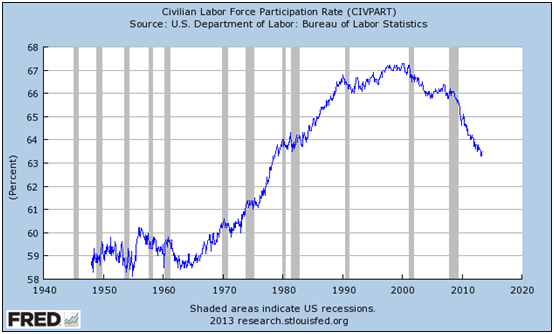
Listening to the leaders at the Fed these days is like hearing the best students in the class arguing with the teacher over a grade. Much of the media seems like parents arguing on their child’s behalf. For the guys at the Fed, who mostly know academia and nothing else, low grades would be crushing if they were not delusional. The class in this case is Real Economy 101 in which the Fed has helped guide the labor participation rate to thirty-year lows. Too many twenty-something’s reside in their parents’ basements for lack of a good job and older workers have given up looking for work in droves.
Nonetheless, our brave students at the Fed are just certain as can be that money velocity will rise sooner or later, as their printed money finally gets put to productive use in the real world. Doubters like us must prove the “counterfactual” (a popular word among the FOMC acolytes these days) that things would be worse without the heroes at the Fed who have rescued us every five years or so from the popping of the bubbles they helped blow.
The FOMC swears it deserves an “A+” because stock prices are so elevated and speculation is rampant again. Numerous pundits praise the wisdom of Chairman Bernanke. However, for the first time we can recall, a number of significant money managers and captains of industry have voiced concerns that a bubble has formed in many asset classes. But the Fed supposedly knows better! Though there is so little real world experience within its ranks, somehow the central bankers’ good grades in school and fancy research papers replete with indecipherable squiggly lines trumps the wisdom of people who really do not have a vested interest in sounding cautious.
We will give them their coveted A+ in one subject: Bubble Formation 101. They have been receiving that grade for over twenty years. Equity bulls are now running over 3.5 to 1 versus bears according to sentiment surveys. Margin debt and mutual funds flows are at euphoric extremes. Tech companies with no earnings are priced into the stratosphere. A++! We also give them an A+ in Capital Misallocation Strategies 101. The FOMC is causing money to flow into markets and not into productive capital. They openly sell the “sizzle” of their magic trick. However, does the Fed think that business decision makers are so naïve as to believe anything in the current environment is real or sustainable? Will higher stock prices lead to job growth?
Why you may ask are we so hard on the Fed. It is because their policies at these extremes help so few and penalize so many, especially savers. Even some from the inside the Fed are beginning to recognize the shortcomings and unintended consequences of current policies. In a recent piece in the Wall Street Journal Andrew Huszar, the man put in charge of the Fed’s mortgage purchase program wrote:
“I can only say: I’m sorry, America. As a former Federal Reserve official, I was responsible for executing the centerpiece program of the Fed’s first plunge into the bond-buying experiment known as quantitative easing. The central bank continues to spin QE as a tool for helping Main Street. But I’ve come to recognize the program for what it really is: the greatest backdoor Wall Street bailout of all time.”
Better late than never we suppose.
By the most important measures, U.S. stocks are the most richly valued that they have ever been in about 100 years of history, in spite of the underlying economy needing life support and pain killers for five years now. We predominantly use normalized earnings to value equities in an effort to adjust for cyclical earnings variability and typical profit margin behavior, but a more direct and less “geeky” way to get to largely the same answer is to compare stocks to annual revenue figures. On that front, data-centric fund manager John Hussman recently wrote:
“While the valuation of the S&P 500 Index itself was higher in 2000, it’s notable that the overvaluation of the S&P 500 was skewed in 2000 by extreme overvaluation in very large-capitalization stocks, while smaller capitalization stocks were much more reasonably valued. In contrast, we have never in history observed the median stock as overvalued as we observe presently. Indeed, the median price/revenue ratio of stocks in the S&P 500 now exceeds the 2000 peak. Likewise, as Damien Cleusix has observed, if we examine valuations by quartiles (25% of stocks in each bin), the average price/revenue ratio of the two middle quartiles also exceeds the 2000 extreme.”
Yet comically, former Chairman Greenspan had the audacity to recently argue stocks are cheap.
The next Fed Chair, Janet Yellen, just told us today during her confirmation hearing that there is no “over leveraging in the markets” and no “misalignment in asset prices.” Why worry?
The views expressed on this blog are the opinions of the authors. This information is not intended as investment advice or to recommend the purchase or sale of securities. More information on Strategic Balance, LLC may be obtained by contacting investor relations.
In theatres now…”Mirage”
Bull markets tend to bring out movies about the world of finance. However, like the bullish Time magazine cover we have mentioned in recent months, they can be powerful contra-indicators. For instance, Wall Street came out in 1987 and Boiler Room arrived in 2000, marking critical turning points after significant market surges. This cycle has brought us a remake of The Great Gatsby (eery timing given our view that we are re-living the 1920’s in many ways) and more recently The Wolf of Wall Street. We have seen neither, but they reminds us how tightly scripted markets have become, as if the writers, directors, and producers somewhere have a story to tell us each trading day, and boy do they stick to the plot. Markets in cycles past have had a similar feel, but nothing like today. Perhaps it is because computer algorithms dominate trading completely and are quite adept at managing prices around the story line 24/7.
We call the current market movie “Mirage.” The script goes like this: the Fed is the heroic protagonist, dropping cash on Wall Street. The prime beneficiary of QE is the S&P 500. The Fed creates an illusion of well-being. Central bankers and policy makers in Europe and Japan wear the white hats too as they play up any signs of growth and promise to do anything they can to support markets. The private sector and the real economy do not even play “bit” parts. According to the script, the FOMC, in its infinite brilliance, will stop printing money at the exact perfect time in the distant future and equities will to continue to thrive as rates remain ultra-low. Villain bonds and precious metals are to be feared because QE might end today and the Fed might actually tighten policy tomorrow. Please pardon the disconnect between our last two statements because that’s what the markets do every day. It’s a gaping hole in the plot, we know.
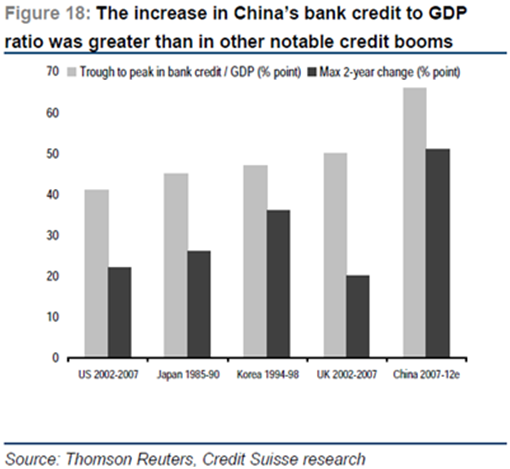
The storyline includes no mention of the massive overbuilding in China, which helped corporate profitability in the U.S immensely, or any other factor that was outside of Fed control, like FASB easing mark-to-market rules for banks. The computers relentlessly trade all asset classes in a tight band around this storyline, as if the movie was completely nonfiction. Huge sums of money are placing identical bets as the herd grows larger, drawn into the engrossing plot. The intrinsic value of securities is not important, just listen to Bernanke. How the computers treat asset classes most days is the only thing that matters in this flick. Momentum rules the roost.
By our best measures, this “movie” has pushed equities to all-time high valuations. Yet apparently many participants feel compelled to buy stocks. Although some are skeptical of this year’s price move in equities and other risky assets like EU bonds, few seem willing to leave the party just yet. What strikes us as astounding is that just about every professional believes they can get out the door at just the right time and are even advising investors to do the same. That doorway will get mighty crowded at some point.
We think we know how the sequel goes. Tepid growth fades to recession because massive global debts simply cannot be overcome in spite of central banks’ liquidity binge. Consumers, businesses, and governments are already overly indebted in the U.S. and many other nations, but the powers-that-be attempt to create ever more debt to grow our way out of the chasm. However, both the desire to borrow and the desire to lend have passed their peaks and additional debt would be quite difficult to service. It is a “Catch 22” that central bank balance sheet expansion cannot defeat; the critical limit has been reached. According to this script, after a few painful years, only debt restructuring can clear the path for future growth. To avoid this pain, every country will continue debasing its currency in a “beggar thy neighbor” strategy to repay obligations with cheaper money, but this just leads to more asset bubbles and future crashes. The sequel will likely include an earnings collapse because of the slowing economy and the unsustainability of current record profit margins. Stocks should correct, but may just go mostly sideways for years. High quality bonds should do well in a flight to quality. Precious metals should rise in a flight to safety, as well as their relative scarcity versus the ever increasing supply of fiat currencies backed by nothing.
If we ever wondered about the long-term impact of QE, we think the cratering of mortgage applications to the lowest levels in twelve year answers the question. Inman News reported that Trulia’s Chief Economist recently tweeted that “increased mortgage rates — which jumped in the spring over worries that the Fed would dial back its stimulus program — have ‘whacked’ refinance applications, and the housing recovery has been too weak to fill the gap with purchase loans.” How real was any supposed housing recovery anyway? It was facilitated by a bunch of hedge funds buying properties and artificially driving up prices in major markets. For instance, the New York Times quoted a local broker who said “maybe 70 percent of the sales we were seeing were to hedge funds, investors and others taking advantage of what was happening in Brooklyn. Only about 30 percent were actual end users or first-time buyers.” This is going on all over the country to various degrees and that’s a problem. What a mirage! Have we learned nothing from the bubble of 2006-2007?
The views expressed on this blog are the opinions of the authors. This information is not intended as investment advice or to recommend the purchase or sale of securities. More information on Strategic Balance, LLC may be obtained by contacting investor relations.